Executive Summary
Here is something that should unsettle every retail leader: consumers are spending more time online than ever, yet e-commerce's share of total retail has stopped growing. The tools keep getting better. The investments keep coming. And yet the line refuses to move. This is not a market problem. It is a workflow problem, and optimising the existing funnel will not fix it.
This paper maps out what comes next: four ages of retail evolution, each building on the one before it, each defined by a different source of competitive advantage. Understanding where you are in that sequence is the most useful thing a retail leader can do right now.
The mandate is simple but uncomfortable - reframe the problem, redesign workflows, and invest in capabilities aligned with this progression. Retailers who act now are already creating distinctions from the market. Those who delay, risk being locked out of meaningful advantage as the window to build lasting differentiation is expected to narrow significantly by 2027.
The Funnel Has Run Out of Room
Around 2019, two things happened at the same time and they didn't make sense together.
The first story looked like a boom. Consumers were online more than ever: more devices, more platforms, more hours. Mobile kept growing. Social media was consuming hours of daily attention. Video became the primary way people discovered and explored products.
The second story was a flat line. In the US, e-commerce was still sitting at roughly 16.9 percent of total retail in Q1 2026 (U.S. Census Bureau), and globally around 20 percent. The 2010s promised a steady march toward thirty, forty, fifty percent online. That march stalled. The curve bent, then flatlined.
The industry's response has been to try harder. Faster page loads. Smarter search. More granular personalisation. More aggressive retargeting. Each year another round of improvements. Each year, smaller returns. A healthy maturing channel should still be taking share, just more slowly. What e-commerce is actually delivering is continued heavy investment against a share-of-retail line that simply refuses to climb.
The easy read is that consumers have hit a natural ceiling for online shopping, or that physical retail is stickier than expected. We don't think that's right. The plateau isn't about demand. It's about design. The funnel was built for a world that no longer exists.
A Workflow Specified for a World That No Longer Exists
The e-commerce funnel (Homepage to Category to Product Listing to Product Detail to Cart to Checkout) was designed in the late 1990s for a very specific situation. Bandwidth was scarce. Mobile didn't exist. Social platforms hadn't appeared. Search was primitive. The funnel was a genuinely clever answer to a narrow problem: how do you sell things to people who arrive on your website already knowing roughly what they want.
That design rested on three assumptions: the consumer arrived with intent, they were making the decision alone, and they were patient enough to work through a structured journey. In 1999, all three were basically true. In 2026, none of them are.
Today's consumer doesn't arrive with intent. They arrive because something five minutes ago nudged them: a reel, a notification, a friend's message, a sudden realisation triggered by weather, tiredness, or a wedding invitation they just received. They aren't searching. They're responding to an impulse. And what greets them? Filters. Category trees. Comparison tools. A funnel asking them to slow down and evaluate, when what they actually want is for someone to confirm the impulse and guide them somewhere they hadn't thought to look.
They're also not alone. Even holding a phone by themselves, they're operating inside a thick web of influence: algorithmic feeds, family group chats, creator recommendations, peer reviews, community wisdom, AI assistants. By the time they reach a retailer's page, the decision has usually already been shaped by forces the retailer never saw.
And they're not patient. Someone who might have spent forty minutes researching a single product in 1999 now decides in three minutes on their phone, often with two screens open at once. Or three seconds on a reel where the buy button is one tap away.
What we're left with is a system that's very good at the narrow moment of transaction, and almost completely blind to everything that happened before the consumer showed up.
Why Optimising the Funnel Is the Wrong Response
Optimisation can only work on what's inside the system you're optimising. The funnel can only convert traffic that actually reaches it. It can do almost nothing about the much larger pool of buying intent that forms and resolves somewhere else entirely, never touching your site at all.
The retailers who figured this out first are mostly not the traditional e-commerce names. Pinduoduo has built one of the world's largest e-commerce businesses through buying groups and gamified social mechanics that bear little resemblance to the standard e-commerce flow. Stitch Fix inverted the funnel entirely, starting not from a catalogue but with the consumer's stated preferences. Skechers, through its ActionIQ and Databricks customer data platform, reported a 324 percent lift in click-through rates and a 68 percent reduction in cost-per-click versus legacy audience lists. The performance matters, but the real breakthrough is in the underlying capability: systems that can sense and respond to the consumer in real time.
None of these results came from squeezing more efficiency out of the existing funnel. They came from stepping outside it entirely and meeting consumers in the places where decisions actually happen.
A market problem is something you learn to live with. A workflow problem is something you fix. The e-commerce plateau is the second kind. Consumers haven't stopped buying. They're buying differently, through different channels, on timelines the funnel was never built to handle.
How people actually buy
The decision forms across many surfaces. The funnel sees only the last one.
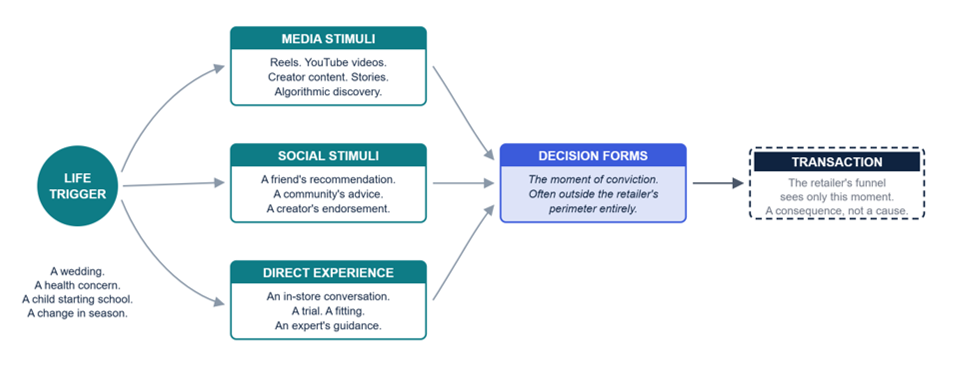
The territory beyond the funnel isn't theoretical. It's where most buying actually happens. Here's what a typical purchase looks like in 2026, not the version your analytics captures, but the version that actually unfolds in someone's life.
A woman in her thirties decides she wants to start running again. It doesn't begin with a search. It begins with a coffee conversation where a friend mentions a running group. Her first action isn't a purchase. It's showing up in the wrong shoes. Two regulars notice and recommend a specialty store that does gait analysis.
That evening, her feeds change. Reels about running form and shoe fitting start appearing. She saves a few. A creator she follows recommends a specific shoe. A physio video explains pronation. She books an appointment. When the purchase finally happens, it's come after gait analysis, expert advice, multiple in-store trials, and a recommendation from someone who's watched her run on a treadmill for thirty minutes.
A month later, she buys her second pair on Amazon. She knows exactly what to search for now. Amazon handles that transaction perfectly. But it had almost nothing to do with how the first one happened.
What the Funnel Sees, and What It Misses
From inside the funnel's analytics, the retailer sees almost nothing: one search at the end, a fast purchase from a brand already chosen. That's the entire visible footprint.
What the funnel doesn't see: the coffee conversation that started it all, the community where strangers gave better recommendations than any marketing campaign, the reels saved, the booking, the appointment after work, the moment the decision became essentially inevitable. By the time she reached checkout, she was executing a decision that had already been made somewhere else entirely.
That's the asymmetry the funnel can't resolve. The retailer who fulfilled the order saw one clean high-intent transaction. The retailer who helped shape the moment of decision was operating in an entirely different place.
Three Sources of Real Buying Behaviour
Walk through enough of these journeys and three patterns show up every time. These are the real sources of buying decisions in 2026.
Media stimuli. The reels people watch, the YouTube creators they trust, the content that surfaces in their feeds in the hours after something happens in their life. Passive in the sense that they weren't searching for it, but highly active in how it shapes preferences and primes decisions. Organic media carries most of the influencing now, and most retailers still don't know how to be part of it.
Social stimuli. A friend. A community. A creator's endorsement. Social influence has always been the strongest force in buying decisions. What's changed is the speed. A recommendation that used to take weeks to spread now travels in hours. One trusted voice can outweigh a multi-million-dollar media campaign.
Life stimuli. A wedding in six weeks. A child starting school. A house move. A change in health. People don't buy products in the abstract. They buy them in response to real things happening in their lives. A retailer that doesn't understand the life context behind a purchase is competing only on product specs.
Real buying decisions almost always emerge from some combination of all three. These are the micro-impulsive moments: moments where media, social, and life signals line up and a purchase becomes suddenly inevitable, often in seconds. The funnel sees none of this. It only sees the moment of execution, the final click after all these forces have already done their work.
Why the Funnel Cannot Serve These Moments
The funnel is built for consumers who show up with intent already formed. But the micro-impulsive moments where decisions actually crystallise happen, by definition, before any consumer ever reaches the funnel. By checkout, the funnel has already lost its chance to shape the decision, and with it the chance to earn the kind of loyalty that comes from being there when it mattered. The retailer who helped shape the decision built a relationship. The retailer who merely executed it got a sale. Both made money. Only one earned something that compounds.
One more thing before we move on, because it sets up something this article comes back to later. Even the richer journey we just described is still a variation on the same underlying pattern. Consumers show up with a stated activity ("I want to start running again," "I need a new skincare routine") and the ecosystem competes to be the best answer within that frame. Almost nobody asks the deeper question: what are you actually trying to achieve, and is this activity really the right way to get there? The wedding in six weeks. The skin condition. Running is one possible answer. So is strength training, better sleep, or a stylist consultation. A retailer that thinks at the level of activities sells the right product. A retailer that thinks at the level of outcomes might offer something different altogether. We'll come back to that shift.
Cognitive Commerce: A New Operating Model with the Consumer at its Centre
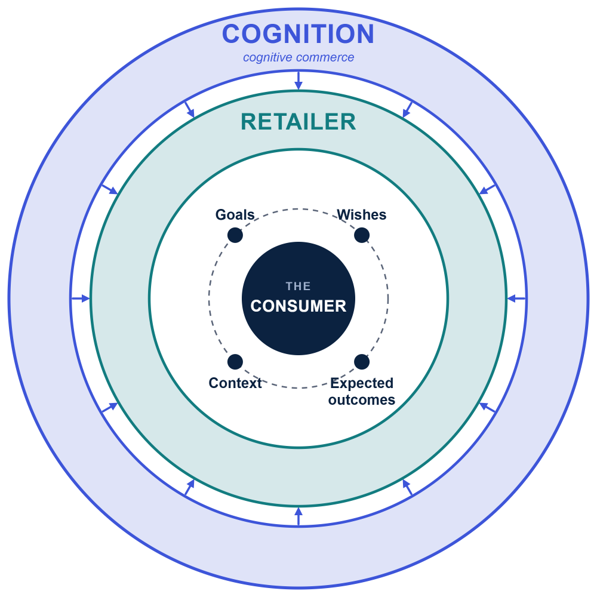
The diagnosis is straightforward. The funnel has hit its ceiling, and consumers moved past its assumptions years ago. What comes next isn't a better funnel. It's a different shape entirely.
That shape needs a name, and the name matters more than it might seem. Call it omnichannel and you'll build a marginally better version of what you already have. Call it unified commerce or headless retail and you'll keep optimising the plumbing. None of those words captures what's actually changing, because all of them describe the retailer's view of the consumer. The real shift goes the other direction. It's the consumer's view of the retailer.
We call this Cognitive Commerce. Cognition is the ability to perceive context, reason over it, and act toward a desired outcome. In retail, it marks the shift from systems that follow instructions to systems that understand intent.
The Definition
Cognitive Commerce is a bidirectional wish-fulfilment model where the consumer expresses goals, contexts, and wants, and the retailer responds with curated outcomes rather than catalogue results. The unit of work isn't the transaction. It's the wish. The measure of success isn't the conversion. It's whether the consumer got what they were actually trying to achieve.
Three ideas carry this shift.
Bidirectional wish-fulfilment: the operating-model shift
In the funnel model, the consumer is a target. The retailer builds a catalogue and waits. The consumer does the hard work of translating their life into search terms. In Cognitive Commerce, the consumer is a participant. The retailer builds capabilities that actually listen: reading intent from queries, voice, behaviour, social signals, and responding with assembled answers. The translation work shifts from the consumer to the retailer.
You can't deliver this by bolting on a better chatbot or an AI layer on top of existing systems. The data architecture needs to ingest signals in real time. Merchandising needs to assemble outcomes, not just feature products. The store needs to function as a node in the consumer's life, not just a destination on their calendar. Most retailers will try to do Cognitive Commerce inside their current operating model. They will fail, because the operating model is exactly what needs to change.
Share of life: the strategic shift
For fifty years, retail has measured success in share of wallet. Of all the money this consumer spends in our category, how much comes to us? It's a clean metric, intuitive and well-understood, and it assumes the consumer's relationship with the category begins and ends at the point of purchase.
Share of life asks something different. Of all the moments, decisions, and contexts in this consumer's life that touch our category, how many are we actually present in? A pet owner might spend three thousand dollars a year in the category. But her life in the category is far larger. She thinks about her dog every day. She worries about its weight. She watches training videos. She's in WhatsApp groups for her breed. She books vet visits. Almost none of those moments produces a transaction. Every one of them is a moment where her life and the category intersect.
The retailer with thirty percent share of wallet but no presence in any of those non-transactional moments is competing on price and convenience. The retailer with twenty percent share of wallet but presence across dozens of those moments is competing on relationship. Over time, the second retailer displaces the first.
Service, not surveillance: the ethical anchor
The same architecture that enables Cognitive Commerce, real-time data, behavioural signals, AI interpretation of intent, can be used in two very different ways. It can serve the consumer better, by understanding their needs deeply enough to be genuinely useful. Or it can extract more from them, by understanding their needs deeply enough to manipulate them. The same technical capabilities support both directions, and the line between them is often invisible to the consumer.
A recommendation engine that uses everything it knows to push basket size is surveillance in a service costume. A recommendation engine that uses everything it knows to help the consumer reach their actual goal, even when that means suggesting less, or nothing at all, is genuine service. Consumers are getting better at telling the difference. Retailers who treat consumer data as a resource to extract will lose trust as fast as social media spreads. Retailers who treat it as a responsibility will earn relationships that compound.
The retailer as a capability, not a place
In the funnel era, the retailer is a place. A store. A website. An app. A surface the consumer has to come to. In Cognitive Commerce, the retailer is a capability. A service that flows to wherever the consumer happens to be: sometimes a store, sometimes a WhatsApp conversation, a creator's livestream, a voice assistant, an AI agent acting on their behalf. The retailer shows up where the consumer is, in the form most useful to that moment.
A retailer that accepts it's a capability rather than a place will, over time, show up everywhere. A retailer that keeps thinking of itself as a destination will shrink to the size of the surfaces it controls.
The Four Ages of Retail
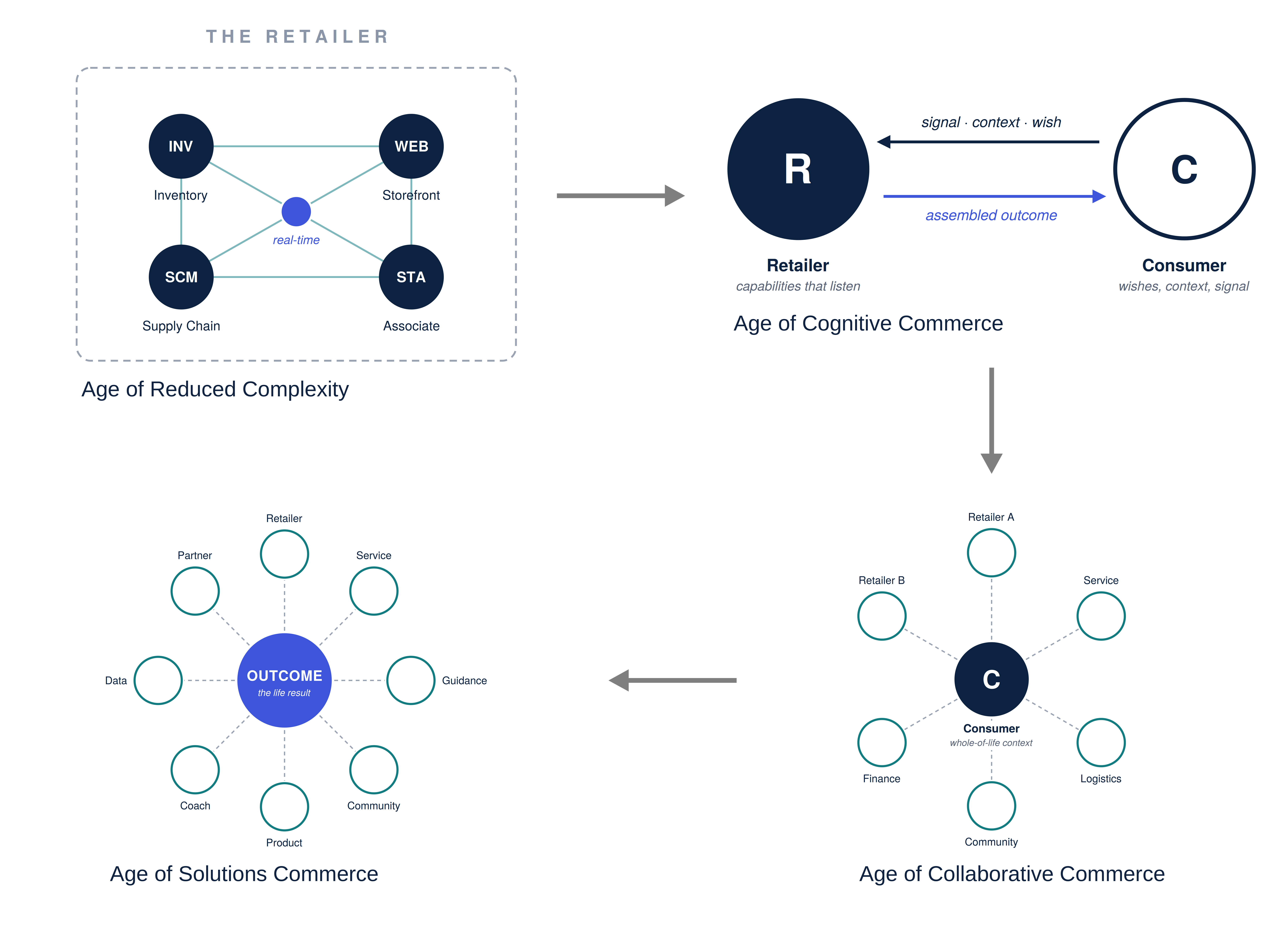
Cognitive Commerce is the operating model the next three years will be built on, but it isn't the final destination. It's the second of four ages. Each one builds on the last. Each one is defined by a different source of competitive power. Together they describe the next decade of retail. Cognition runs through every one of them, deepening as each age builds on the last.
The sequence isn't optional. You can't skip ahead. The sequence is the whole argument.
Age 1 - Reduced Complexity, Powered by Sentience
This is the age most retailers are working through right now. The defining capability is sentience: the ability of the retailer's systems to become genuinely aware of their own state and the consumer's state, in real time. The inventory knows where it is and what's moving. The storefront knows who's browsing. The supply chain anticipates demand. The store associate knows the customer's history before the conversation starts.
As sentience grows, the human effort spent bridging between systems starts to collapse. The integration meetings, the manual reconciliations, the spreadsheets holding everything together: all of these exist because the underlying architecture can't pass information cleanly between its own components. As systems absorb that burden, internal complexity starts to fall away.
This is foundational work. It's largely architectural, usually invisible to consumers, and easy to undervalue because it doesn't produce an immediate revenue line. But without it, none of the next three ages is reachable.
Skechers, as noted earlier, rebuilt its data foundation around a customer-centric architecture, replacing fragmented channel-specific systems with a unified, real-time view of each consumer , and then used ActionIQ with Databricks to activate that view in media. The reported lift in click-through and reduction in cost-per-click is striking, but more important achievement is the substrate underneath those metrices, systems that can sense the consumer in real time. Walmart's investments in unified order management, real-time inventory visibility, and modular commerce architecture sit in the same age, at a different scale but with the same logic. The retailer who can see itself clearly, in real time, is the retailer who can begin to act intelligently on what it sees.
Age 2 - Cognitive Commerce, Powered by Intelligence
This is the age this article has spent the most time on. The defining capability is intelligence, in two senses: machine learning that gets sharper with every consumer signal, and increasingly autonomous AI agents that will, within a few years, routinely act on the consumer's behalf. That second form of intelligence changes what bidirectional wish-fulfilment actually means. The relationship is no longer just between a human consumer and the retailer's own surfaces. It extends to third-party agents acting for the consumer, querying and transacting through structured channels. Cognitive Commerce in its full form is a retailer whose capabilities are machine-readable and agent-addressable, not just one that added a chatbot to its app.
Both forms of intelligence depend on the sentient foundation from Age 1. A retailer whose data refreshes overnight cannot deliver real-time wish-fulfilment. Cognitive Commerce is what becomes possible once sentience is already in place. The retailer stops merely sensing and starts responding.
Some retailers are already meaningfully in this age. Under Armour's HOVR connected running shoes embed a sensor in the midsole that pairs with MapMyRun to coach the runner in real time. The product listens to what the runner is actually doing, not what they typed into a search bar. That's bidirectional wish-fulfilment in physical form.
Sephora's Virtual Artist lets consumers try on makeup virtually and refines recommendations over time as it learns skin types, preferences, and lighting. The retailer isn't waiting for the consumer to navigate to a product page. It's present in the decision moment, often days or weeks before any transaction.
Stitch Fix's curation model shows it from another angle. A detailed intake questionnaire, a data science engine, and stylists who translate wishes into actual products. The consumer doesn't browse. They express themselves, and the retailer responds. The transaction is downstream of the conversation. The model is the conversation.
None of these retailers is operating at the full scale of Cognitive Commerce yet. They're early movers, with parts of their operations running on the new logic while other parts still sit on funnel-era assumptions. Many retailers will spend the next three years looking like they've entered this age, deploying AI overlays, upgrading personalisation engines, announcing consumer-centricity, while remaining structurally in Age 1. Without an operating model reorganised around consumer signal and outcome assembly, it's just Reduced Complexity with a Cognitive Commerce coat of paint.
Age 3 - Collaborative Commerce, Powered by Partnership
The third age sits roughly in the 2028 to 2032 horizon. The defining capability is partnership.
No single retailer, however consumer-centric, can cover the full context of a consumer's life. A new parent doesn't just need diapers. She needs a paediatrician, a daycare, a savings plan, a stroller, an insurance policy, a community of other new parents, a meal-planning service, and a pharmacy that understands what babies actually get sick from. A homeowner renovating a kitchen needs design, contractors, appliances, materials, financing, inspections, and interior planning, from different providers on different timelines.
Cognitive Commerce can serve someone well within the walls of a single retailer. Collaborative Commerce serves them across those walls, by enabling non-competing businesses to coordinate around the consumer's whole life. The shift is from competing for the transaction to collaborating for the person's life. This is the hardest age for traditional retailers to embrace, because it means giving up the closed-loop assumption that's defined retail for a century.
The enabling architecture is starting to emerge. Intent transfer across partners means the consumer expresses a need once and the network coordinates the response without making her repeat herself. Sophisticated “Stores within stores” spaces are the physical version of this idea. Alo Yoga's Sanctuary stores combine retail, yoga studios, and wellness cafés in one space, with different categories collaborating around a shared wellness outcome instead of competing within their own silos.
India's Open Network for Digital Commerce (ONDC) is one of the most compelling early signals of where this age leads. It's an open commerce protocol that lets small retailers, large retailers, logistics providers, and payment systems coordinate without any single player owning the whole stack. A consumer expresses intent on any participating platform, and the network routes fulfilment to whichever providers are best placed to deliver it. Interoperability and standardised intent transfer are baked into the design in a way that closed-loop retailers will find very hard to replicate.
Age 4 - Solutions Commerce, Powered by Outcomes
Age 4 is the furthest out in time and the most consequential. It returns to a question planted earlier in this article. When a consumer expresses an activity ("I want to start running again," "I need a new skincare routine"), the whole ecosystem competes to be the best provider within that frame. But the activity is rarely the actual goal. It's one possible route to it.
The runner wanted to feel confident at her cousin's wedding. Running was one possible answer. So was strength training, dietary change, better sleep, a stylist consultation, or some combination. The whole ecosystem competed to sell her the best version of the activity she'd stated. None of it competed to ask whether that activity was actually the right one. Solutions Commerce starts to close that gap.
In this age, consumers increasingly express the outcome rather than the activity. "I want to feel confident at my cousin's wedding in six weeks." "I want my skin to be calm by the time my visa interview comes around." The retailer, or more often a network of retailers and service providers operating on a Collaborative Commerce architecture, responds by assembling the bundle of products, services, and guidance that actually delivers that outcome. The individual product disappears into the solution.
Petco's Vetco Total Care ecosystem is the clearest early signal. Petco isn't just a pet store anymore. It runs in-store veterinary hospitals, vaccination clinics, grooming, training, food, and behavioural guidance, all organised around keeping a pet healthy over its lifetime. The transaction for a bag of food becomes almost incidental. The outcome and the relationship are what compound.
Tatcha offers a signal from a different category. Tatcha doesn't just sell moisturiser. It sells a daily skincare ritual and the outcome of calmer, clearer skin. The product is real, but the ritual is the actual offer and the outcome is the whole point. Once consumers internalise the ritual, switching brands carries a relational cost, not just a transactional one.
The full Age of Solutions Commerce is unlikely to arrive before the early‑to‑mid-2030s. But its shape is visible now, in the retailers already asking not "What can we sell this consumer?" but "What can we help this consumer accomplish?" The mindset shift here is the biggest of the four: from being the retailer that sells the most products to being the retailer that delivers the best outcomes.
Why the Sequence Matters
The four ages aren't options on a menu. They're a sequence, and the logic of that sequence can't be skipped.
Cognitive Commerce is impossible without the sentient infrastructure of Age 1. Signal can't flow if the plumbing isn't there. Collaborative Commerce is impossible without the consumer-centric architecture of Age 2. Partners can't coordinate around a consumer they can't see clearly. Solutions Commerce is impossible without the partnership networks of Age 3. Meaningful outcomes require multiple parties working together. You can run tactical experiments in later ages, but lasting advantage only comes when the enabling foundations are actually in place.
With each age, where value lives shifts. In Reduced Complexity, it lives inside the retailer's internal capability. In Cognitive Commerce, it lives in the retailer-consumer relationship. In Collaborative Commerce, it lives in the network. In Solutions Commerce, it lives in the consumer's life itself. Each step demands a more advanced form of intelligence: sentience as awareness of state, intelligence as understanding of intent, partnership as coordinated action across boundaries, outcomes as the prediction and delivery of real life results.
Across all four ages, one thing deepens continuously: intelligence. A retailer that completes this progression isn't running e-commerce with intelligence bolted on. It's running a fundamentally different kind of business, one where intelligence isn't a feature of the storefront but the condition the whole enterprise operates on, reaching across merchandising, supply, pricing, fulfilment, and the consumer relationship rather than waiting for instructions function by function. Cognitive Commerce names the second of these ages, but cognition is the thread that runs through all four, from sentience through to solutions. It deepens at every stage rather than arriving at a final one.
Where Retailers Stand Today
For any C-suite reader, this framework is a diagnostic tool. The question isn't which age sounds most exciting. It's where your organisation actually sits on the arc right now. And the temptation, almost universally, is to overestimate.
A retailer that's rebuilt its data foundation but still organises merchandising around categories rather than consumer outcomes is still in Age 1. A retailer with strong personalisation in one channel and disconnected experiences everywhere else is in Age 1 with Age 2 ambitions. Genuine Cognitive Commerce only happens when the operating model itself has been reorganised around consumer signal and outcome assembly, not when the marketing team has adopted a new vocabulary.
Most retailers, on honest reflection, are in the first age. The leaders are early in Age 2. Nobody is operating deeply in Age 3. Age 4 is still a horizon. That's not a discouraging diagnosis. It's the most useful place to start from.
Imperatives and the Window Ahead
The analysis is done. What remains is the practical question: what does this actually require of retail leaders?
Four Imperatives for the C-Suite
These aren't gentle suggestions. They're the positions a retail leader needs to hold to be genuinely competitive in the next decade. The absence of any one of them is a gap a competitor will eventually find.
One – Treat Cognitive Commerce as an operating-model decision, not a marketing one
The most common mistake over the next three years will be treating Cognitive Commerce as a marketing initiative. An extra personalisation layer. An AI overlay. It's none of these. It's an operating-model decision that simultaneously reshapes the customer data platform, the merchandising organisation, store leadership, technology architecture, and the partner economics, all at once.
Here's a simple test: if the "Cognitive Commerce" work in your organisation can be paused without changing how you actually operate, it isn't Cognitive Commerce yet. It's decoration on the funnel.
Two – Choose two or three categories and earn the right to entangle
Cognitive Commerce isn't a capability you can spray across every category at once. It's built category by category, around the specific jobs consumers are hiring the retailer to help with. Pet (Petco), beauty (Sephora), fashion (Stitch Fix), and lifestyle (Alo) are the categories where early movers have shown what genuine entanglement with a consumer's life looks like.
The discipline required here is restraint. Most retailers will be tempted to roll this out as a blanket capability across every category. They'll fail, because shallow entanglement across many categories creates far less value than deep entanglement in a few.
Three – Build the data foundation now, not when the regulation arrives
The retailers who will benefit most from the next shift in consumer data regulation are the ones who already know how to act on rich, real-time customer signals. The architectural building blocks (event streams, identity resolution, real-time CDPs) are well understood. The harder part is cultural: analytics teams that sit close to the merchant rather than in central IT, data products owned by the business, and executives willing to fund infrastructure that doesn't have an obvious campaign attached to it.
A useful test for any retail CIO: can your organisation answer the question "what does this individual customer need this week?" in real time, across all channels, right now? If not, that's the foundation that needs building. Not a recommendation engine. The foundation beneath one.
Four – Benchmark honestly against where the leaders already are
Retailers who lost ground over the last decade mostly did so because they overestimated where they stood. They benchmarked against last year's roadmap rather than this year's leaders and found the gap only once it had become uncrossable.
Four questions, answered honestly. Have we rebuilt our architecture for sentience and modularity, or are we still patching the legacy stack? Do our products and services listen and respond, or do they sit and wait to be found? Are we participating in partner ecosystems, or defending a closed loop? Are we starting to deliver outcomes rather than just products in any of our categories?
A retailer that can't answer yes to at least the first two of those by end of 2026 is not in the running for the next decade. That's uncomfortable to say. It's also accurate.
A Practical Starting Sequence
Imperatives tell you where to stand. A sequence tells you how to move. Here are six steps, meant to run over thirty-six to forty-eight months, with each stage properly measured before the next is funded.
Run a consumer-context audit. Map every moment in your customer's life where your brand should be present and currently isn't. Most retailers run this exercise and find they're absent from a dozen or more contexts that genuinely matter to their customers. That list becomes the brief for everything that follows.
Identify two or three categories with the right to entangle. Apply two filters. Credibility: where do consumers already see you as a genuine authority? Depth: where do your range and operational expertise support a deeper relationship? The overlap is your starting territory.
Build the real-time data foundation. Build a real-time, multi-channel, identity-resolved view of the consumer's behaviour, context, and stated wishes. Litmus7's framing for this is the Retail-live-state Intelligent Data Platform (RiDP), which uses a broad set of signals from both seller and buyer to maintain a micro dynamic persona of each consumer that evolves continuously. It's a step beyond conventional CDPs, built for a world where the consumer's context changes hour by hour.
Pilot wish-sensing in your existing channels. Bring Progressive Wish Assimilation into your live customer-facing surfaces: the website, the app, the assisted-selling experience. Turn unstructured consumer intent into implicit product discovery and curated outcomes. Start in one category. Measure whether the consumer feels understood rather than tracked.
Build owned community and content surfaces. Dependence on rented platforms is a genuine strategic exposure. The economics are worsening and the audiences are fragmenting. Invest in community and content surfaces you own. Litmus7's framing for this capability is SocialChatter. Even a modest investment here compounds more reliably over five years than an equivalent spend on transient paid media.
Evolving loyalty into advocacy. The traditional points-and-tiers model is nearing the end of its useful life. The next generation of loyalty recognises and rewards consumer-to-consumer influence. Litmus7's framing for this is Distributed Loyalty, built on the recognition that an enthusiastic consumer generates more value through their network than through their own basket.
The Window Ahead
Every era of retail has had its inflection point. Sears at the turn of mass merchandising. Walmart at the rise of EDLP and supply-chain integration. Amazon at the shift from physical to digital primacy. We're at another one. The convergence of agentic commerce, voice and ambient interfaces, and platform economics shifts is rewriting what competitive advantage in retail actually means.
The rough timing on this convergence is 2027. That's not a hard deadline. It's the point at which early movers' structural advantage becomes durable enough that latecomers can't meaningfully close the gap through technology alone.
A retailer that has built the real-time data foundation, run the consumer context audit, chosen focus categories, deployed wish-sensing channels, established owned community surfaces, and evolved loyalty into advocacy by 2027 will have compounded those capabilities into customer relationships that late entrants simply cannot replicate quickly. The data is years deep. The trust is earned, not claimed. The operating model has been rewired. A retailer that has done this work isn't just ahead. It's operating in a category its competitors haven't recognised yet.
The retailer that hasn't done this work by 2027 will spend the years after discovering, often the hard way, that the gap isn't about access to technology. The tools are broadly available to everyone. The gap is in accumulated signal, depth of consumer relationships, and operating model maturity: assets that can't be installed in a quarter.
The retailers who win the next decade won't be the ones who built better funnels. They'll be the ones who understood their consumers well enough to be genuinely useful, quietly, contextually, in the moments that actually mattered. That's the standard. The window for meeting it is open. It won't stay open.