

A low-code observability platform designed to address immediate reporting needs across business and support teams, with a strong focus on post-purchase processes and order management/order processing. This solution effectively eliminates the challenges associated with modeling and generating frequent or ad hoc reports for various business and support requirements. The platform's low-code framework, combined with a robust and intuitive UI/UX component layer, empowers users to effortlessly configure and maintain enriched reports with minimal developer involvement
- Personalized Dashboards
- Zero Overheads & Maximum Productivity by empowering teams for configuring Reports
- Easy configurations with minimum developer involvement
- Enriched UI/UX components providing flexible and accurate reporting

In store customers discover discounted price and applicable promotions only during the checkout process. When consumers are presented with unexpected costs , they may abandon their carts before completing their purchase.
Additionally, these platforms commonly employ an attribute-based schema model to maintain business-specific custom details. However, the interpretation of these attributes is typically unique to each implementation or account, further complicating integration and usability.
Moreover, these SaaS platforms lack advanced business intelligence features, resulting in a heavy dependence on developers for minor adjustments or the creation of new, on demand reports. The scope of reporting is generally confined to the OMS framework, with limited or no capability to integrate or extrapolate data across related systems, restricting the overall utility and scalability of the platform.
Solution Considerations
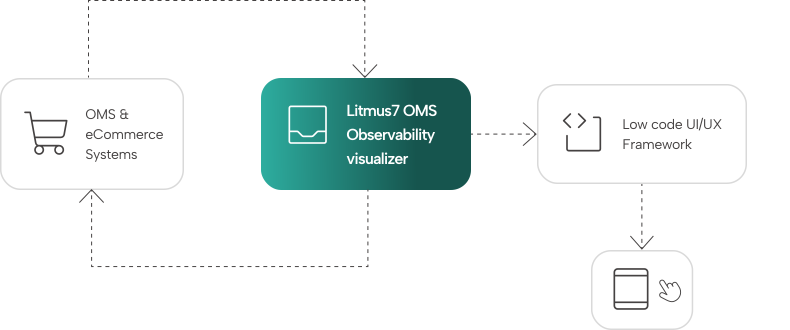
- A Standalone application: Designed for seamless integration with OMS platforms for data ingestion.
- Zero Impact on OMS Performance: Ensures no performance bottlenecks are induced to core OMS capabilities.
- Real-Time Analytics: Provides real-time insights by processing transactions from the OMS, fully aligned with an event-driven architecture.
- Customizable Data Mapping: Supports tailored data mapping from the OMS to the reporting tool, addressing limitations of the attribute model concept.
- Extensible Reporting: Enables developers to add new reports to the platform using the published data model.
- Future-Ready Design: Includes a robust roadmap to develop a near no-code platform,leveraging advanced Gen-AI concepts for schema interpretation and data retrieval using NLP.
- No Vendor Lock-In: Offers flexible hosting options, either on-premise or in the cloud, as per the client’s preference.
- Enhanced Business Intelligence: Supports both business intelligence reporting and ondemand reporting with minimal developer involvement.
- Beyond OMS: Extends capabilities beyond the OMS platform, providing a framework to incorporate additional data from related retailer systems for comprehensive observability.

Enhanced Querying
Enables querying by attribute name, allowing for detailed and customized report generation.

Customizable UI for Enriched Visualization
Offers advanced business analytics with a highly customizable UI, enabling intuitive and insightful data visualization.

Flexible Query Model
Supports the creation and execution of custom queries without restrictions, tailored to specific reporting needs.

Business Empowerment
Provides deeper insights and operational efficiencies through precise reporting capabilities that go beyond native OMS functionalities. Empowers business teams to create on-demand reports with minimal reliance on developers.
Flexible Data Management
Supports onetime data loading, event-driven updates, and scheduled updates, offering versatile data management options.
Event-Driven Architecture
Ensures near real-time data synchronization through a fully event-driven framework.
Enhanced Integration
Extends integration capabilities to include related systems, enabling comprehensive reports and improved observability.
Headless Architecture
Features a fully headless design that exposes configured queries as API models. This flexibility allows retailers to leverage the solution's out-of-the-box (OOB) UI framework, integrate existing reporting frameworks, or consume APIs as needed for enriched reporting.
Standalone and Decomposed Solution
Operates independently from the OMS platform, delivering robust functionality without impacting core OMS performance.



